
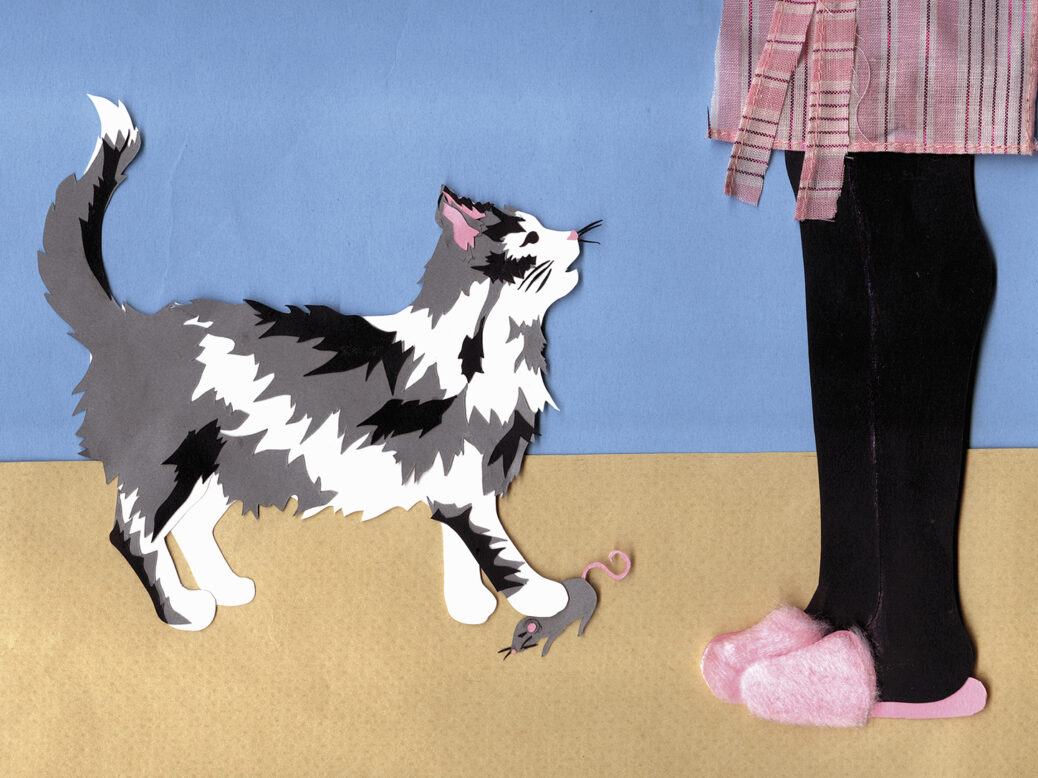
Oh the depths of conversation one can have with a cat. “You’re a cat!” “Do you know you’re a cat?” “Are you a good cat?” To which my cat – and, I would venture, every cat – responds with a slow blink of disdained resignation, quite clearly replying: “You foolish human, I am obviously the best cat.”
For eight years, this has been the rapport between Clio, the adorable tortoiseshell I rescued from a cramped flat in Kingston, and the humans with which she shares a home. And I thought that acceptable. But a podcast recommendation (The Allusionist, in which Helen Zaltzman unpacks the secrets of language) has sent me down a rabbit hole into the weird, wonderful world of “augmentative interspecies communication” (AIC).
If it sounds terrifyingly futuristic, that’s all the more fitting, as one of the poster-cats for this technology is cared for by the sci-fi author Mary Robinette Kowal. Kowal has taught Elsie, her seven-year-old calico, to communicate by pressing buttons that play pre-recorded words – according to Elsie’s Instagram, she knows over 120 words. The cat does not just use her buttons to tell Kowal what she wants to play with or demand food: she can ask questions, negotiate and complain. (Yes, this is a cat that will tell you to your face that you are too loud and she wants you to leave.) She can also express a wider range of emotions than one would necessarily expect from a feline, like gratitude, remorse or grief.
At this point, readers may suspect I have gone mad. Cats can’t talk. It must be an elaborate trick. And certainly the depths of Elsie’s apparent conceptual understanding (“rude”, “soon”, “sorry”) seem incredible. But no one has much trouble accepting that dogs (especially breeds known to be clever, for whom this technology was originally designed) can have vocabularies similar to that of a human toddler. True, cats are far harder to train, but lack of biddability does not equal lack of intelligence. Back in 2019 a Japanese study found that, contrary to popular belief, cats know their own names – they just don’t always care to respond to them. A separate study three years later suggests they can learn the names of other cats, too. So why not the names of toys, places or feelings?

Having watched Elsie diligently trying (without success) to explain, for example, why she is so perturbed by a watering can, I do not see a cat performing tricks for its owner’s content stream. I see an animal experiencing confusion and using the communication tools available to convey that emotion. Elsie has buttons; other cats rely on flattened ears, swishy tails, or persistent meows (a language adult cats use exclusively to talk to us humans). We know they’re trying to tell us something. But transmission is only half the equation. The other half is whether or not we can learn to understand them.
I suspect Clio would not get on well with AIC buttons. While her instinctive grasp of physics is astounding when, say, balancing on top of a fence, her general intellect is at the lower end of the feline spectrum. She recognises the sound of our returning footsteps long before a key turns in the lock, she can always sense when we’re ill or sad, and I’m fairly sure she understands the words “tuna” and “bacon”. But protracted debates about whether playtime is now or later are probably beyond her.
Still, Kowal’s adventures in figuring out what Elsie is actually saying to her have had an impact in our home. When Clio yowls at me as I’m lying in bed at the end of the day, I always assume she’s demanding an early supper and ignore her. But what if she’s trying to say something else? The night before last, I responded to her indignant cries by getting out the laser pointer and sent her careening around the room chasing that elusive red dot. Last night, instead of yowling, she put her paw on my hand. No buttons needed to parse that one. OK Clio, we can play with the laser. And yes, you are definitely the best cat.
[Further reading: Confessions of a bibliomaniac]
Content from our partners


Related



This article appears in the 06 May 2026 issue of the New Statesman, Tis but a scratch
Join the debate
Subscribe here to comment